The 2026 World Cup Is Already Full of Drama - And It Hasn't Even Started

The numbers alone should be enough to stop you mid-scroll. Forty-eight nations. One hundred and four matches. Three host countries — the United States, Canada, and Mexico — spanning thousands of kilometres and four time zones. The 2026 FIFA World Cup is not just the biggest tournament in football history. It is the biggest single sporting event the world has ever staged.
And yet the tournament's most gripping storylines have not come from the pitch in New York or Los Angeles or Vancouver. They have come from the qualifying rounds — the playoff shootouts and heartbreaking near-misses and shock returners that have been quietly rewriting football history for the past two years. Before a single ball is kicked in anger this summer, here is what you need to know.
Italy: The Unthinkable, For the Third Time
There is a particular kind of silence that follows the final whistle of a penalty shootout loss in a World Cup playoff. Italy have now heard it three times in a row.
The Azzurri's elimination at the hands of Bosnia and Herzegovina was the third consecutive occasion — following the North Macedonia disaster in 2022 and the Sweden play-off exit in 2018 — that a nation with four World Cup titles failed to qualify. For context: Italy has won the tournament more than France, more than England, more times than anyone except Brazil and Germany. They invented the catenaccio. They gave the world Maldini and Baggio and Pirlo and Buffon.
And they are watching this summer on television.
The structural issues run deep. Italian football's youth development pipeline — once the envy of Europe — has been outpaced by nations who adopted the high-press, high-energy models that dominate the modern game. Serie A's international standing has declined. The tactical rigidity that once made the Azzurri so fearsome now reads as predictability to opponents who have studied them carefully.
What the Bosnia loss did was strip away the "freak result" narrative Italy clung to after 2018. This is not bad luck. This is a systemic problem that a federation full of tradition has been slow to confront. The conversation in Italy is no longer "who is to blame for this qualifying campaign." It is "what does Italian football become now?"
A nation that has not missed a World Cup since 1958 has now missed three in a row. The reckoning is overdue.
Iraq: The Lions of Mesopotamia Return
Forty years is a long time. In 1986, the world was a different place — and Iraqi football was, briefly, a presence at the sport's highest stage. Their squad that year included players who had grown up in a country where football was, even under difficult circumstances, a source of genuine national pride. They lost all three group stage matches. But they were there.
What follows in the decades between 1986 and 2026 is a story that football cannot fully contain. Wars, sanctions, the near-total destruction of national infrastructure. A federation that barely functioned. Players who developed their talent in diaspora clubs across Europe and Australia and the Americas, carrying Iraqi identity with them across borders. Generations who grew up knowing their national team primarily as a story of what might have been.
The 2026 return of the Lions of Mesopotamia is, in the most genuine sense, more than football. The squad that qualified brings together an extraordinary mixture of European-developed talent and players who came through Iraq's slowly rebuilding domestic system. Their Asian qualifying campaign was not a fluke — it was methodical, defensively organised, and driven by a generation of players who understand exactly what it means to represent this particular flag at this particular tournament.
When Iraq walk out for their first match this summer, the watching world would do well to pay attention. This is a story forty years in the making.
Sweden: The Potter Project Takes Flight
When Graham Potter left Brighton for Chelsea in 2022, the football world watched a fascinating managerial career get pulled sharply sideways by the gravitational pull of a billionaire's cheque book. The Chelsea tenure is well-documented. What interests us here is what happened next.
Potter's return to management — taking charge of Sweden — looked, at first, like a temporary arrangement for a coach regrouping after a bruising education in the Premier League's ownership circus. It has since become something considerably more interesting.
Under Potter, Sweden have rediscovered a tactical fluency that had been absent from their game since the Ibrahimovic era. The high press, the fluid positional interchange, the willingness to play out from the back under pressure — these are not typically Swedish footballing traits, and that novelty has confounded opponents who prepared for a more direct approach. Their qualifying run was built on defensive solidity and clinical counter-attacking, with an intensity that belied their relatively modest FIFA ranking.
Are Sweden genuine contenders? The honest answer is: probably not for the trophy. But in a 48-team tournament structured to reward consistency across a group stage, Sweden are precisely the sort of side who accumulate points quietly, make the knockout rounds, and then become everyone's nightmare draw. Potter knows how to build teams that are greater than the sum of their parts. He did it at Swansea, at Brighton, and he appears to be doing it again.
Watch Sweden in the group stage. Then watch them again in the round of 32.
Group A: Mexico's Mountain Fortress
The 2026 World Cup draw handed Mexico something that no other co-host received: home advantage in the most literal possible sense.
The Estadio Azteca sits at 2,240 metres above sea level. For visiting teams unused to altitude, the effects are well-documented — reduced cardiovascular efficiency, faster onset of fatigue, slower recovery. Mexico have been playing there for decades. Their players do not experience altitude. They exploit it.
Add to this the context surrounding Guillermo Ochoa, the goalkeeper who has somehow been the best player in multiple World Cup tournaments despite Mexico's persistent inability to progress beyond the Round of 16. At 40 years old, this is almost certainly Ochoa's final World Cup — and the veteran is making no secret of the fact that he intends to go out on his terms. Mexico at altitude, in front of their own supporters, with their goalkeeper in his final chapter: this is not a Group A to underestimate.
El Tri's squad has genuine quality in midfield and attacking positions. The question, as it always is with Mexico, is whether the squad can finally breach the curse of the Round of 16 that has plagued them for decades. Ochoa's presence as both a goalkeeper and a talisman may be the final missing piece.
This is a side playing for history. Back them accordingly.
Son Heung-min: The Last Dance at Peak Powers
There is a particular quality to watching a great athlete in the final tournament of their career when they are still, undeniably, at or near their very best. We saw it with Zidane in 2006, with Lahm in 2014, with Modric threading passes in his mid-thirties. We are about to see it with Son Heung-min.
The Tottenham captain is currently in the form of his professional life. Goals and assists at club level have been consistent; his movement, his reading of space, his clinical finishing in key moments — all remain as sharp as they were five years ago. The difference now is context. Son knows this is the last time. The performances suggest someone who has made peace with that fact and decided to leave absolutely nothing on the table.
South Korea's draw and group schedule will determine how far Son can carry his side. But in terms of individual impact, in terms of moments that will define the tournament's narrative, Son Heung-min is the player to watch. His combination of big-game experience — Champions League semi-finals, Premier League title races, previous World Cups — and current form makes him the most compelling Golden Boot candidate outside of the traditional European powerhouses.
If Son ends his World Cup career with a Golden Boot, it will be one of the great individual tournament stories of the modern era. The odds might underrate him. They probably do.
Turkey: The Dark Horse Everyone Ignores
The 2026 tournament will produce dark horses. It always does. The question is which teams the pundits are underestimating right now, while they still have odds worth backing in your office pool.
Turkey deserves more attention than they typically receive.
Their qualifying campaign was built on an intense pressing game and a generation of technically gifted players who have developed across top European leagues. The squad has Premier League quality — not fringe contributions, but genuinely influential players in title-competing sides. Their tactical approach is aggressive, high-energy, and structured to prevent opponents from establishing rhythm.
Turkey's history at major tournaments is marked by the spectacular and the unexpected. The 2002 World Cup third-place finish remains one of the competition's great surprises. The Euro 2024 campaign showed flashes of what this current generation is capable of when the pieces align. At a 48-team tournament that virtually guarantees upsets in every group section, Turkey are positioned to be the team that nobody adequately prepares for until it is too late.
The Scale of What Is Coming
It is worth pausing to fully absorb the scope of this tournament. Forty-eight teams. One hundred and four matches. Three host nations — the United States hosting the majority of fixtures, Canada providing venues in the north, Mexico bringing the iconic Azteca back to World Cup action for the third time. The format expansion means that eight additional nations have qualified compared to the previous 32-team structure.
Eight nations who would have been watching at home are instead preparing their squads. Eight qualifying campaigns that produced the stories above — Iraq's 40-year return, Italy's heartbreak, Sweden's renaissance.
The group stage runs across sixteen groups of three teams. The format rewards winning, punishes draws more than previous tournaments, and creates the possibility of third-place finishers from competitive groups advancing as best third-placed sides. It is a format designed to generate drama, eliminate predictability, and keep fans engaged across approximately six weeks of football.
This is the biggest sporting event in human history. It will produce storylines we cannot yet imagine.
Your World Cup: Make Every Match Count
Here is the thing about the 2026 World Cup: you will never watch all 104 matches on your own. Nobody will. The tournament is too long, too spread across time zones, and too packed with fixtures to consume as a solitary experience.
The World Cup is a communal sport. It was always meant to be watched in groups — debating picks before kickoff, arguing about calls in real time, tracking where you stand against your mates on the leaderboard after every result. The 2026 tournament is the best possible excuse to set up a proper tipping competition and finally retire the WhatsApp group and the shared spreadsheet that nobody trusts.
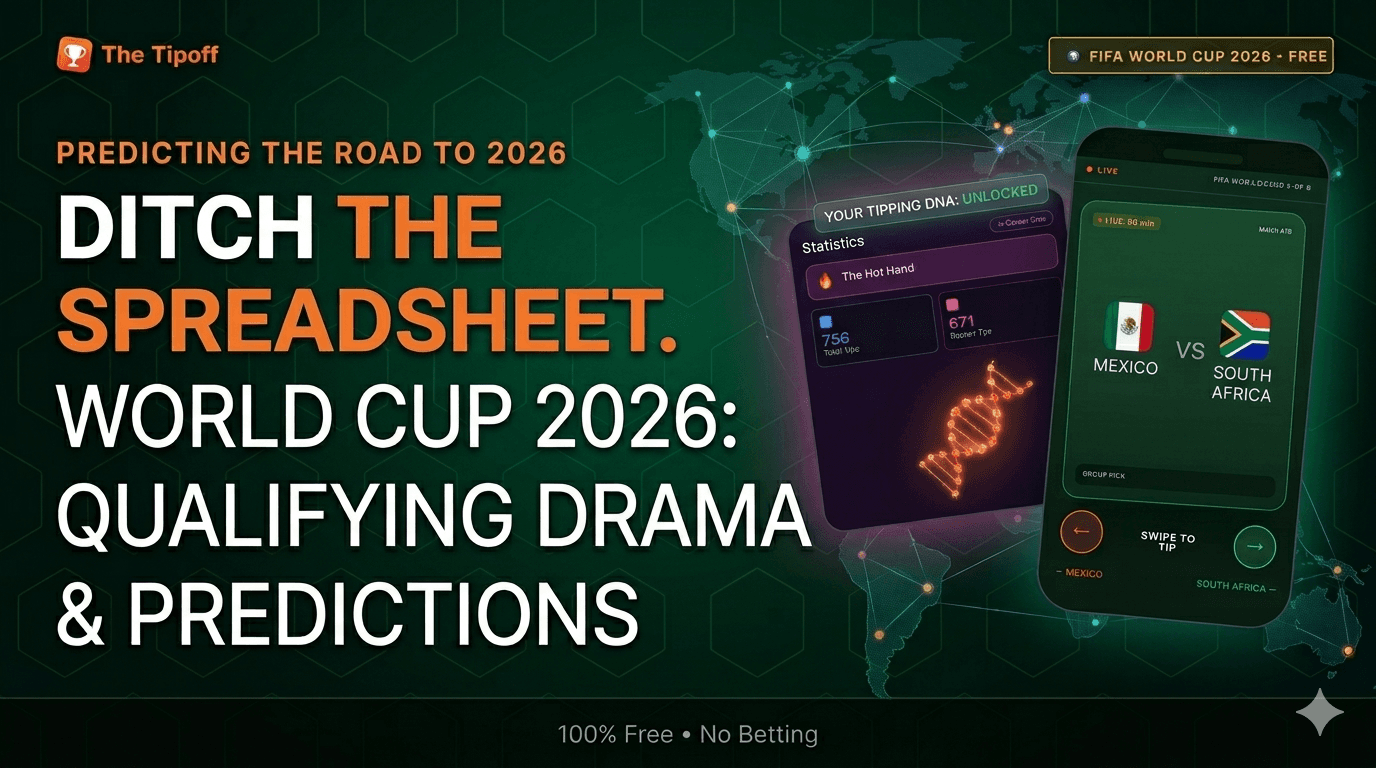
The Tipoff was built for exactly this. A free sports prediction platform that handles the entire competition automatically — so the person running the group actually gets to watch the football instead of manually updating scores at midnight.
What you get with The Tipoff
Predict every match across all 104 fixtures — picks lock automatically at kickoff, no editing after the first goal
Private leagues for your workplace, friendship group, or venue — invite by link, code, or QR, with no cap on group size
Real-time leaderboards that update automatically as results settle — zero admin required after setup
The Match Wall — a live group feed that activates when a match goes live; react to goals and follow the drama with your inner circle
Tipping DNA profiles that turn every pick into a personality breakdown — are you the Comeback Kid or a Chaos Agent?
Achievements and badges for streaks, accuracy milestones, and bold calls — earned in real time, all shareable
Your Circle — follow specific mates and track exactly where you stand against them on the global leaderboard
100% free, no betting — ever. No credit card, no subscription, no gambling mechanic. Safe for workplaces, schools, and venues.
The Commissioner sets it up once, shares the link, and then gets to actually watch the tournament. The leaderboard, the settlement, the badges — all automatic.
Ready for the Tournament?
The 2026 World Cup is almost here. Italy will be watching from home. Iraq will be carrying four decades of history onto the pitch. Son Heung-min will be chasing a Golden Boot in his final chapter. Mexico will defend altitude and legacy in front of their own supporters. Sweden will quietly make everyone regret ignoring them.
There has never been a better time to run a tipping competition. And there has never been a better platform to run it on.
Set up your group at The Tipoff — it takes less than five minutes, and the first pick locks at the opening whistle at the Azteca.
Related Articles

How to Run a 2026 World Cup Tipping Competition at Your Pub, Bar or Sporting Club
A complete guide for pub managers, bar owners, sporting club social coordinators, and community event organisers on running a free World Cup tipping competition — QR code setup, no gambling license required, keeps patrons coming back all 104 matches.

The World Cup Starts in 5 Weeks. Does Your Group Have a Plan?
The 2026 FIFA World Cup kicks off June 12. Five weeks to test your football knowledge, set up your group, and make sure you're not the one confidently tipping the wrong team.